Amazon PPC for Beauty Brands: 2026 Strategy by Spend Tier
Read more
.png)
At $500K a month, beauty brands win by running a full-funnel Amazon strategy for incremental profit and category leadership, not by simply spending more.
Summarize in ChatGPT
At $500K a month in beauty, the strategy that got you here starts to work against you. Pouring more budget into the same Sponsored Products campaigns raises your cost per sale long before it raises your profit.
The brands that break through stop buying volume and start buying incremental growth.
This guide lays out how a beauty brand at half a million a month should build its Amazon advertising strategy: how to allocate across the funnel, when awareness formats earn their place, how to prove incrementality, and how to defend the brand you have built.
It assumes you are past the launch phase and need an operating model, not a starter checklist.
At this scale, advertising shifts from acquisition-led growth to a full-funnel system judged on incremental profit and category position. The metrics that mattered at $50K quietly stop telling the truth.
Below a few hundred thousand a month, a tight Sponsored Products account can carry most of the growth. Past $500K, that engine hits a ceiling.
You have already captured the high-intent searches, so the next dollar of pure search spend often buys demand you would have won anyway.
The operating burden changes as well.
Running four ad types with different metrics, plus DSP and AMC, is more than a part-time job, which is why brands at this size usually move from a generalist to a senior operator or specialist team.
Complexity, not budget, is what forces that shift.
Growth now comes from creating demand, not just capturing it, which is why the full funnel stops being optional.
The questions change too: not how low is my ACoS, but how much did this spend actually add, and am I leading my category or defending it.
The tier logic behind that shift is covered in our guide on Amazon PPC for beauty brands by spend tier.
Category leadership is the real prize at this stage. At $500K you are large enough to shape a category's search landscape, and share of the queries that matter becomes a strategic asset that protects your margin as competition rises.
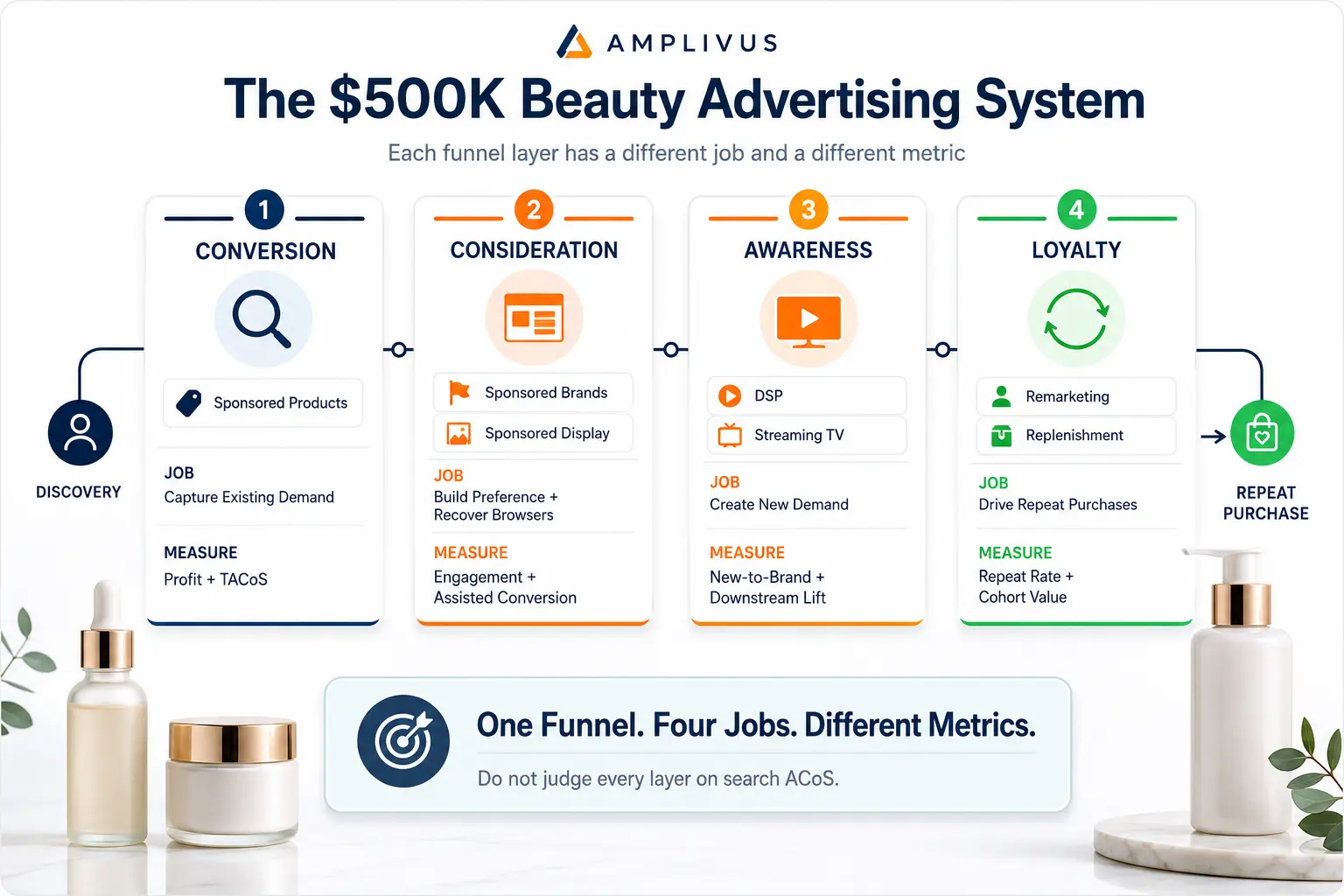
Split budget by funnel role: conversion with Sponsored Products, consideration with Sponsored Brands and Display, awareness with DSP and Streaming TV, and loyalty with remarketing. Each layer does a different job and needs a different metric.
The point of funnel allocation is that judging every layer on a single ACoS breaks the system. Beauty is visual and story-driven, so the upper funnel earns its keep here far more than in a commodity category.
Sponsored Products stays the profit core, capturing shoppers already searching for what you sell.
At $500K, the work here is efficiency and structure, not growth: tight match types, clean negatives, and disciplined bids so this layer funds the rest.
Do not expect this layer to scale the brand on its own. Its job is to convert existing demand profitably, which is exactly why leaning on it for growth is what stalls brands at this size.
The mechanics of pushing it further sit in our guide on scaling beauty PPC past $100K a month.
Placement and timing are where extra efficiency hides. Weighting bids toward the placements and hours a beauty term actually converts frees budget the upper funnel can then use.
At $500K, small efficiency gains in this layer fund meaningful awareness elsewhere.
This is where beauty brands earn attention rather than just harvest it. Sponsored Brands, especially video, shows the product in use, and Sponsored Display follows shoppers who viewed but did not buy.
For a visual category, creative is the lever, not just the bid. A strong Sponsored Brands Video can lift consideration across the whole catalog, while Sponsored Display retargeting recovers the browsers a single search ad never closes.
Treat creative as a testable asset, not a one-time upload. Rotating video angles, refreshing your Store, and testing lifestyle imagery tell you what actually moves consideration, and the winners lift the whole catalog rather than a single ASIN.
Awareness is what a $500K brand can add that a smaller one cannot afford. Amazon DSP runs programmatic display and video to reach shoppers before they search, building the demand your lower funnel later captures.
Streaming TV ads, formerly Sponsored TV, extend that reach onto Prime Video, Twitch, and Fire TV with no minimum spend, so even a mid-market beauty brand can run television-style awareness.
Judge these formats on new-to-brand and downstream lift, never on a search ACoS.
Awareness also demands patience and the right attribution window. These formats plant demand that converts days or weeks later, so a same-day view will always undersell them.
Set the measurement window to match the buying cycle before you judge the spend.
Beauty is consumable, so retention is a growth channel, not an afterthought. Serums, cosmetics, and treatments run out, which makes the repeat buyer the most profitable audience you have.
DSP remarketing keeps your brand in front of past buyers as they approach reorder, and pairing that with Subscribe and Save turns one sale into a subscription. Retention spend often carries the lowest effective cost in the entire plan.
Measure this layer on repeat rate and cohort value, not last-click ACoS. A serum buyer who reorders three times a year is worth far more than a single order suggests, and Brand Analytics repeat-purchase data is where that value becomes visible.
Because a large budget can easily pay for sales you would win anyway, so incrementality is what separates real growth from wasted spend.
It is the discipline that keeps a big number honest.
At $500K, the biggest risk is not underspending; it is spending on demand you already own.
Aggressive bids on your own brand terms, or broad upper-funnel budgets with no measurement, can post a healthy ACoS while adding almost nothing.
The fix is to measure lift, not just efficiency.
Holdout tests, where you withhold ads from a segment and watch what sales do, reveal what spend truly added. New-to-brand metrics show whether you are acquiring or repeating, and Amazon Marketing Cloud ties these signals together across the funnel.
A branded-term test makes the point. Pause brand-defense ads for a controlled window and watch whether those sales simply move to organic.
If they do, the spend was low-incremental; if sales drop, the defense was earning its place. Either answer is worth having.
Most beauty brands skip this step, and it is the one that keeps scale from hiding waste. Without a lift measurement, a bigger budget simply buries inefficiency behind a bigger revenue line.
Defend by owning your branded search and conquesting rivals, because protecting earned demand costs far less than acquiring cold traffic. At this scale, defense is some of the most efficient spend you have.
Once you have built a brand worth searching for, competitors will bid on your name, and shoppers ready to buy you are the cheapest conversions on the platform.
Losing them to a rival's ad at the last moment is an expensive leak.
Sponsored Brands holds the top of your branded results, and Sponsored Display protects your product pages from competitor placements.
The same tools let you conquest, appearing on rivals' terms where your product genuinely wins. Beauty brands that skip defense quietly fund their competitors' growth.
Defense also feeds the paid-to-organic flywheel. A strong paid presence on your own terms reinforces organic rank, a dynamic we cover in our guide on the beauty PPC halo effect.
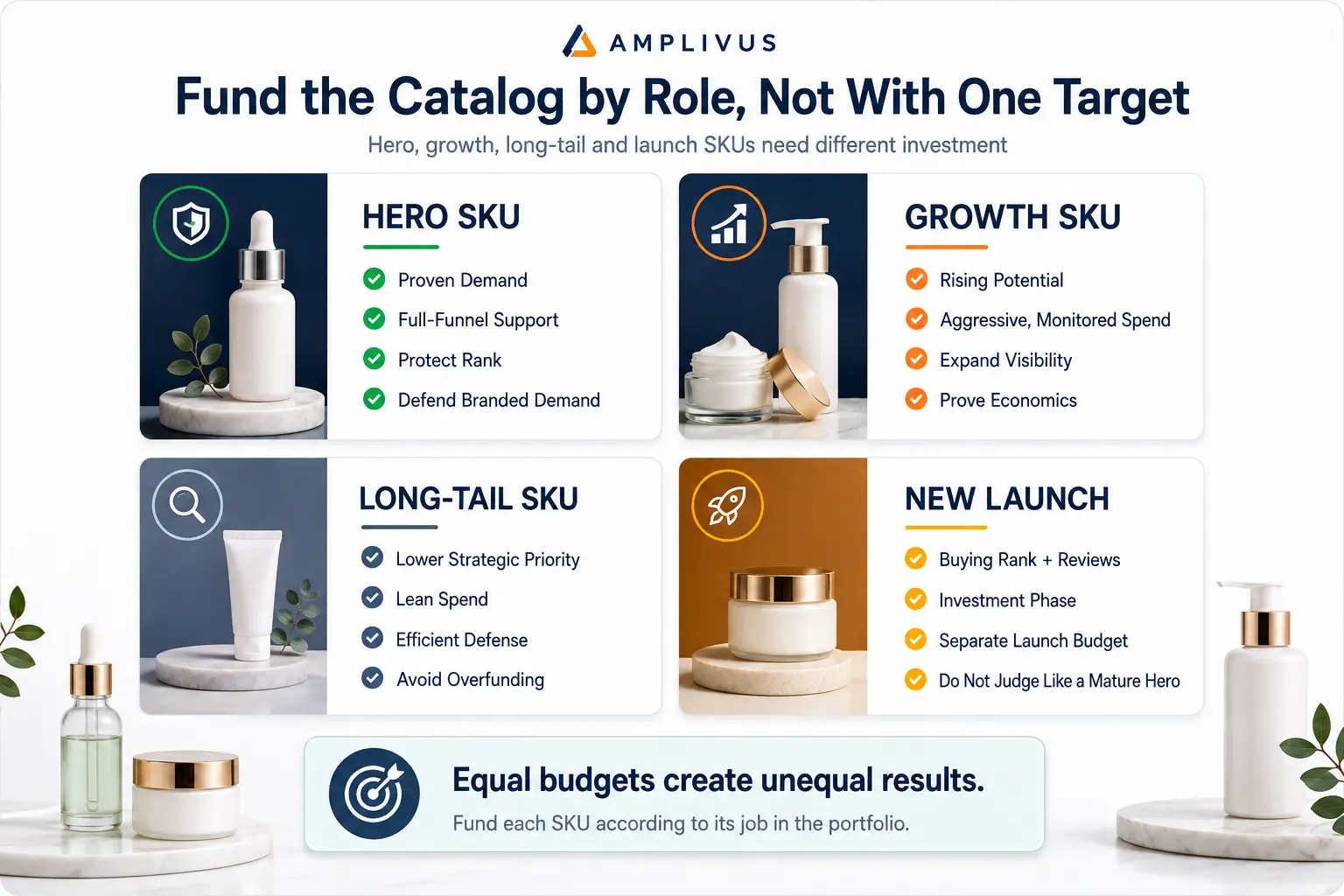
Assign each SKU a role, hero, growth, or long-tail, and budget by that role rather than applying one target across the whole catalog. A varied catalog rewards varied spend.
A $500K beauty range is rarely uniform. A few hero SKUs drive most of the revenue, a handful of growth products are climbing, and a long tail fills out the range. Funding them all identically wastes money on some and starves others.
Hero SKUs justify full-funnel investment because their rank and reviews compound over time. Growth SKUs deserve aggressive but watched spend, while long-tail products should run lean, defended but rarely pushed.
The full-funnel mechanics for skincare specifically are laid out in our guide on full-funnel Amazon ads for skincare brands.
New launches inside a mature catalog need their own rule. A fresh SKU cannot be judged on the same efficiency as a hero product, because it is still buying rank and reviews.
Fund launches as investments with a timeline, not against a day-one ACoS.
Combine Brand Analytics and SQP for market share, campaign reports for efficiency, and AMC for incrementality, all judged against TACoS and profit. No single metric can run a full-funnel strategy.
You cannot manage awareness on ACoS alone. Brand Analytics and Search Query Performance show your share of each query and where you are gaining or losing the market, which matters more at this scale than any one efficiency number.
Layer campaign data for efficiency, new-to-brand for acquisition, and lift measurement for the upper funnel, then judge the whole system on total advertising cost of sale and profit.
A strategy measured only on ACoS will always underfund the awareness that grows a beauty brand.
Set a review cadence to match the stack. Weekly for lower-funnel bid moves, monthly for full-funnel budget shifts, and quarterly for the bigger allocation questions.
A full-funnel strategy reviewed only when results dip is really a strategy running itself.
Build from the bottom up: fix conversion first, add consideration, then layer awareness once the lower funnel can capture the demand it creates. Sequencing prevents expensive waste.
Turning on DSP or Streaming TV before Sponsored Products is clean and efficient is a common, costly error. Awareness creates demand, and if your conversion layer leaks, you are paying twice to lose the same shopper.
Get Sponsored Products structured and efficient, prove Sponsored Brands and Display are lifting consideration, and only then scale awareness with measurement attached. Each layer should be earning its place before the next one is switched on.
The common mistakes are judging every layer on ACoS, skipping incrementality, neglecting brand defense, and treating the catalog as one target.
Each one traces back to running a mature brand like a bigger small one.
The first is applying a search ACoS to the whole funnel, which strangles awareness before it can work. Upper-funnel formats look expensive on a last-click view and valuable on a lift view.
The second is scaling spend without measuring incrementality, so a larger budget quietly hides growing waste. The third is ignoring brand defense until a competitor is already taking the buyers you earned.
The fourth is one-target budgeting across a varied catalog, which overspends on the long tail and underfunds the heroes. Fixing these is less about new tactics than about changing what you measure and why.
As a specialist Amazon PPC agency, Amplivus builds full-funnel beauty strategy around incremental profit rather than vanity efficiency, so every layer of spend has a defined job and a way to measure it.
That includes Sponsored Brands management for creative-led consideration and brand defense, and Sponsored Display management to retarget browsers and protect your product pages from rivals.
If you want a clear read on where your beauty spend is incremental and where it is not, a free Amazon PPC audit maps the gaps first. A short Amazon strategy session then turns that into a full-funnel plan for the year ahead.

Build a stronger beauty advertising system with smarter funnel allocation, better brand defense, and a clear plan for incremental profit.
Book a strategy call to review your funnel, incrementality, brand defense, and the highest-value moves for your brand.